
Event Information:
-
Ter20Out2026Qui05Nov2026Online
Online Course Fire Evacuation - From Theory to Practice
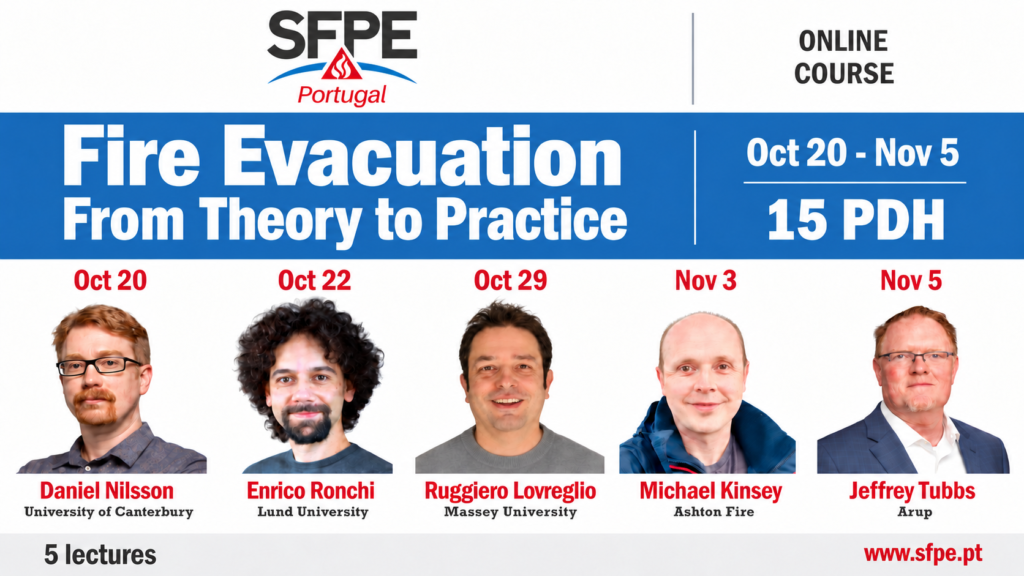
Fire Evacuation - From Theory to Practice
Oct 20 to Nov 5, 2026 | 5 lectures | 15 PDH
Online
Introduction
Every egress design rests on an assumption about people. How long an occupant takes to recognise the alarm and start moving, which exit they choose, whether they follow the illuminated sign or retrace the way they came in: these are the variables that decide whether a building empties in time. Prescriptive codes answer them with fixed values. Four decades of research on human behaviour in fire show that the real answer depends on the occupants, on the building and on the information available at the moment of the decision.
Fire Evacuation - From Theory to Practice brings that body of knowledge to the design table. Five lectures, 15 PDH in total, delivered online by five speakers who have shaped both the research and its application in practice. The course runs from the classical theories and concepts of human behaviour in fire to the computer models used to calculate Required Safe Egress Time, with their verification, validation and limitations; it then covers BIM and artificial intelligence workflows and decision-making under uncertainty, and closes with the design of holistic life-safety and egress strategies for complex buildings and emerging risks.
The course is intended for fire safety engineers and designers, architects, evacuation modellers, safety officers, authorities having jurisdiction and researchers working with means of egress and evacuation analysis.
Participants receive a certificate of attendance stating the PDH awarded.
Programme
LECTURE 1 · Oct 20
Human Behaviour in Fire - Theories and Concepts
Daniel Nilsson | University of Canterbury, New Zealand
The first lecture focuses on the classical theories and concepts in the area of Human Behaviour in Fire, which includes the RSET model (engineering model), behaviour sequences, role-rule model, affiliation theory and social influence. In addition, factors influencing human decision making in emergencies will be discussed, such as risk perception. The lecture will also explore the myth of "panic" by explaining the definition and relating it to real-world events. The aim of the lecture is to provide practicing engineers with the tools to better understand and predict evacuation behaviour, which will lead to more representative and accurate design assumptions about people’s evacuation response.
LECTURE 2 · Oct 22
Computer Simulation Models for Building Evacuation
Enrico Ronchi | Lund University, Sweden
Evacuation models are important tools in fire safety engineering for assessing how occupants may respond and move during fire emergencies and calculate the Required Safe Egress Times in performance-based design. These computer-based simulation tools can represent aspects of human behaviour, occupant movement, evacuation times, and crowd dynamics, providing valuable insight into the evacuation process. This lecture provides an overview of evacuation models, focusing on their main modelling assumptions related to space representation, pre-travel and movement phases. It also considers the approaches they adopt to represent the impact of fire smoke on evacuation movement and behaviour, together with key topics such as verification and validation and the uncertainties associated with the modelling outputs. Overall, the lecture highlights the capabilities and limitations of evacuation models and their role in supporting fire safety engineering.
LECTURE 3 · Oct 29
Connecting the Digital Dots of Evacuation: BIM and Artificial Intelligence
Ruggiero Lovreglio | Massey University, New Zealand
This lecture begins by introducing the concepts of Building Information Modelling (BIM) and openBIM. It then provides an overview of the workflows available for evacuation and fire simulations, including existing commercial and open-source solutions that support BIM-based fire safety design.
It also introduces the foundations of Artificial Intelligence (AI) and Machine Learning (ML), including their basic principles and capabilities for fire engineering. Finally, it provides a brief introduction to Generative AI (GenAI) and Large Language Models (LLMs), with a focus on how these technologies can be used to automate BIM workflows and support the definition of fire and evacuation scenarios.
LECTURE 4 · Nov 3
Decision-Making in Fire Evacuations: Heuristics, Memory, and Uncertainty
Michael Kinsey | Ashton Fire, United Kingdom
This lecture discusses some of the key facets of how people make decisions during fire evacuations. It begins by considering the challenges of researching human decision-making in fire, along with the sources of data available and how these ultimately inform and limit the extent of our understanding. General psychological concepts relating to decision-making are then presented, including heuristics, cognitive biases, and memory and forgetting, drawing on the psychological literature. These concepts are then connected to how people make decisions during fire evacuations, considering how decision-making is predicated on the coupling of past training and knowledge of a building with information received from the environment during a fire, and how people may forget or fail to recall certain information, requiring decisions to be made under uncertainty. Examples of common decision-making behaviours observed during evacuations are then presented, followed by case studies of past notable fires where such behaviours are exemplified. The lecture closes by considering uncertainty and variability in human behaviour, and how this can inform the various methods available to account for such behaviour.
LECTURE 5 · Nov 5
Effective Evacuation Design: Moving From Compliance to Coordinated Life Safety Strategies
Jeffrey Tubbs | Arup, United States
Safe and effective evacuation is not achieved through compliant egress features alone. While these features provide an essential baseline, they are only one component of integrated Life Safety Strategies – designed around people, credible emergency scenarios, building performance, operations, and emergency response. This lecture presents a practical, outcome-focused framework for developing egress systems that support comprehensive Life Safety Strategies. Topics include emergency pre-planning, evacuation strategy development, notification and communication systems, and the factors that enable occupants to recognize threats, understand what actions to take, and reach a place of safety under realistic emergency conditions.
Speakers
Daniel Nilsson | University of Canterbury
Professor at Civil and Natural Resources Engineering at the University of Canterbury, New Zealand, and Director at Fire Research Group Ltd. His area of expertise is Human Behaviour in Fire, with research focused on the interaction between people and evacuation systems, such as way-finding systems and fire alarms. His PhD examined how people’s choice of exit can be influenced by different visual way-finding systems; later studies covered visual and auditory way-finding in smoke-filled tunnels and the design of fire alarms and way-finding systems in high-rise buildings. In 2013 he was appointed Reader in Fire Safety Engineering at Lund University. He is the author of several scientific publications, including a chapter in the 5th edition of the SFPE Handbook written with Rita Fahy, NFPA.
Enrico Ronchi | PhD MSc (Hons) BSc, Lund University
Associate Professor at Lund University, Sweden, recognised for his research contributions on human behaviour in fire and evacuation. He is responsible at Lund University for the International Master of Fire Safety Engineering (IMFSE), a joint programme led by Ghent University, and holds guest teaching appointments at Ghent University and ETH Zurich. His work has been published in over 200 scientific publications, more than 100 of them peer-reviewed journal papers. He is Associate Editor for Fire Technology and Safety Science and a member of the editorial board of Fire Safety Journal, and translates his work into practice through committees and publications with SFPE, ISO, the Fire Protection Research Foundation at NFPA and several governmental agencies.
Ruggiero Lovreglio | PhD MEng BEng, Massey University
Professor of Digital Built Environment and Fire Engineering at Massey University, New Zealand, and a Rutherford Discovery Fellow. His research focuses on human behaviour in disasters, evacuation modelling, fire safety, and technology-enhanced training using artificial intelligence, virtual reality, augmented reality and building information modelling. He serves as Associate Editor for several journals, including Safety Science and Fire Technology. He has received the SFPE 5 Under 35 Award and the Massey Research Medal for Early Career Research.
Michael Kinsey | PhD CEng BSc (Hons) MIFireE, Ashton Fire
Chartered Fire Engineer, Technical Director and researcher, supporting design teams in creating buildings that are safer during fires, with experience across commercial, residential, rail, stadium and rolling stock projects. His particular interest is how people behave during fire evacuations, combining research with modelling tools to support better design decisions. He is a British Standards Institution committee member involved in writing UK fire design guidance, co-author of the 2nd edition of the SFPE Guide to Human Behaviour and of the SFPE Handbook’s evacuation modelling chapter, and sits on ISO TC92/SC4/WG4, which is developing international protocols for evacuation model verification and validation. He is also Visiting Lecturer in the Built Environment at Birmingham City University.
Jeffrey Tubbs | PE FSFPE, Arup
Principal with Arup in Boston, SFPE Fellow and member of the SFPE Board, with over 30 years of engineering and leadership experience and Engineer-of-Record on projects for nearly three decades. Notable clients include Harvard University, MIT, DFW International Airport, Hamad International Airport, Marina Bay Sands and multiple MBTA rail projects; he also assisted the NIST NCST investigation of The Station nightclub fire. He has served as Chair of the IBC Means of Egress Committee, the IBC Fire Safety Committee and the NFPA 101 Life Safety Code Correlating Committee. He is lead Section Editor for the 6th edition of the SFPE Handbook of Fire Protection Engineering, lead author of two of its chapters, and lead author of Egress Design Solutions (Wiley, 2007).
Calendar
DATE LECTURE SPEAKER TIME Oct 20 Tuesday
Human Behaviour in Fire - Theories and Concepts Daniel Nilsson 9:00-12:00 CEST 8:00-11:00 PT/UK
Oct 22 Thursday
Computer Simulation Models for Building Evacuation Enrico Ronchi 9:00-12:00 CEST 8:00-11:00 PT/UK
Oct 29 Thursday
Connecting the Digital Dots of Evacuation: BIM and Artificial Intelligence Ruggiero Lovreglio 9:00-12:00 CET 8:00-11:00 PT/UK
Nov 3 Tuesday
Decision-Making in Fire Evacuations: Heuristics, Memory, and Uncertainty Michael Kinsey 14:00-17:00 CET 13:00-16:00 PT/UK
Nov 5 Thursday
Effective Evacuation Design: Moving From Compliance to Coordinated Life Safety Strategies Jeffrey Tubbs 14:00-17:00 CET 13:00-16:00 PT/UK
Format
Online. Each lecture lasts three hours, with time reserved for questions.
Payment Conditions
- Registration is confirmed by an initial payment of 50 EUR, which secures the place.
- The remaining balance must be settled no later than 15 days before the course starts.
- The initial payment of 50 EUR is refundable only in duly documented cases of force majeure.
- Participation depends on full payment of the registration fee within the period stated above.
Your registration is only valid after payment of the registration fee. Please pay by bank transfer to IBAN PT50 0035 0736 00023205630 57 | BIC SWIFT CGDIPTPL (AESCI - Associação para a Engenharia de Segurança) and send the proof of transfer by email to info@sfpe.pt, entering your name in the transfer description.
Registrations
|PT|
Fire Evacuation - From Theory to Practice
20 de outubro a 5 de novembro de 2026 | 5 lectures | 15 PDH
Online
Enquadramento
Todo o dimensionamento dos caminhos de evacuação assenta num pressuposto sobre as pessoas. O tempo que um ocupante demora a reconhecer o alarme e a iniciar o movimento, a saída que escolhe, se segue o sinal iluminado ou refaz o caminho por onde entrou: são estas as variáveis que determinam se um edifício se esvazia a tempo. A regulamentação prescritiva responde-lhes com valores fixos. Quatro décadas de investigação sobre comportamento humano em situação de incêndio mostram que a resposta depende dos ocupantes, do edifício e da informação disponível no momento da decisão.
O curso Fire Evacuation - From Theory to Practice traz esse conhecimento para a mesa de projeto. São cinco lectures, num total de 15 PDH, em formato online, com cinco speakers que construíram tanto a investigação como a sua aplicação prática. O percurso vai das teorias e conceitos clássicos do comportamento humano em incêndio aos modelos computacionais usados para calcular o Required Safe Egress Time, com a respetiva verificação, validação e limitações, passa pelos fluxos de trabalho em BIM e inteligência artificial e pela tomada de decisão em contexto de incerteza, e termina na conceção de estratégias integradas de segurança de pessoas e de evacuação para edifícios complexos e riscos emergentes.
Destina-se a projetistas e especialistas de SCIE, arquitetos, engenheiros, técnicos que trabalham com modelação de evacuação, responsáveis de segurança, entidades com competência de apreciação de projetos e investigadores.
As lectures decorrem em inglês, sem tradução. Os participantes recebem o certificado de participação com indicação dos PDH atribuídos.
Programa
LECTURE 1 · 20 de outubro
Human Behaviour in Fire - Theories and Concepts
Daniel Nilsson | University of Canterbury, Nova Zelândia
A primeira lecture centra-se nas teorias e conceitos clássicos do comportamento humano em incêndio, incluindo o modelo RSET (modelo de engenharia), as sequências de comportamento, o modelo role-rule, a teoria da afiliação e a influência social. Serão ainda discutidos os fatores que influenciam a tomada de decisão em emergência, como a perceção do risco. A lecture explora também o mito do «pânico», explicando a definição do termo e confrontando-a com eventos reais. O objetivo é dotar os profissionais de ferramentas para compreender e prever melhor o comportamento em evacuação, conduzindo a pressupostos de projeto mais representativos e rigorosos sobre a resposta das pessoas.
LECTURE 2 · 22 de outubro
Computer Simulation Models for Building Evacuation
Enrico Ronchi | Lund University, Suécia
Os modelos de evacuação são ferramentas importantes na engenharia de segurança contra incêndios, quer para avaliar como os ocupantes respondem e se movimentam em situação de incêndio, quer para calcular o Required Safe Egress Time no projeto baseado no desempenho. Estas ferramentas de simulação representam aspetos do comportamento humano, do movimento dos ocupantes, dos tempos de evacuação e da dinâmica de multidões. Esta lecture faz uma panorâmica dos modelos de evacuação, com foco nos principais pressupostos de modelação relativos à representação do espaço e às fases de pré-movimento e de movimento. Aborda também as abordagens adotadas para representar o efeito do fumo no movimento e no comportamento durante a evacuação, bem como a verificação e validação dos modelos e as incertezas associadas aos resultados produzidos. No conjunto, evidenciam-se as capacidades e as limitações dos modelos de evacuação e o seu papel de apoio à engenharia de segurança contra incêndios.
LECTURE 3 · 29 de outubro
Connecting the Digital Dots of Evacuation: BIM and Artificial Intelligence
Ruggiero Lovreglio | Massey University, Nova Zelândia
Esta lecture começa por introduzir os conceitos de Building Information Modelling (BIM) e de openBIM. Apresenta em seguida uma panorâmica dos fluxos de trabalho disponíveis para simulação de evacuação e de incêndio, incluindo as soluções comerciais e de código aberto que suportam o projeto de segurança contra incêndios com base em BIM.
Introduz ainda os fundamentos da inteligência artificial (IA) e da aprendizagem automática (ML), incluindo os seus princípios básicos e potencialidades para a engenharia de segurança contra incêndios. Termina com uma breve introdução à IA generativa (GenAI) e aos grandes modelos de linguagem (LLM), com foco no modo como estas tecnologias podem automatizar fluxos de trabalho em BIM e apoiar a definição de cenários de incêndio e de evacuação.
LECTURE 4 · 3 de novembro
Decision-Making in Fire Evacuations: Heuristics, Memory, and Uncertainty
Michael Kinsey | Ashton Fire, Reino Unido
Esta lecture aborda facetas essenciais do modo como as pessoas tomam decisões durante uma evacuação em situação de incêndio. Começa por considerar os desafios de investigar a tomada de decisão humana em incêndio, as fontes de dados disponíveis e o modo como estas informam e limitam o nosso conhecimento. São depois apresentados conceitos gerais da psicologia da decisão, incluindo heurísticas, enviesamentos cognitivos, memória e esquecimento. Estes conceitos são ligados à forma como as pessoas decidem durante uma evacuação, considerando que a decisão assenta na articulação entre a formação e o conhecimento prévio do edifício e a informação recebida do ambiente durante o incêndio, e que as pessoas podem esquecer ou não conseguir recordar determinada informação, tendo de decidir em contexto de incerteza. São apresentados exemplos de comportamentos de decisão frequentes em evacuações e casos de estudo de incêndios notáveis que os ilustram. A lecture encerra com a incerteza e a variabilidade do comportamento humano e o modo como estas podem ser consideradas nos vários métodos disponíveis.
LECTURE 5 · 5 de novembro
Effective Evacuation Design: Moving From Compliance to Coordinated Life Safety Strategies
Jeffrey Tubbs | Arup, Estados Unidos
Oradores
Daniel Nilsson | University of Canterbury
Professor em Civil and Natural Resources Engineering na University of Canterbury, Nova Zelândia, e Diretor da Fire Research Group Ltd. A sua área de especialidade é o comportamento humano em incêndio, com investigação centrada na interação entre as pessoas e os sistemas de evacuação, designadamente sistemas de orientação visual e alarmes de incêndio. No doutoramento estudou o modo como a escolha da saída é influenciada por diferentes sistemas visuais de orientação; trabalhos posteriores incidiram sobre orientação visual e sonora em túneis com fumo e sobre o projeto de alarmes e de sistemas de orientação em edifícios de grande altura. Em 2013 foi nomeado Reader em Fire Safety Engineering na Lund University. É autor de diversas publicações científicas, entre as quais um capítulo da 5.ª edição do SFPE Handbook, escrito com Rita Fahy, da NFPA.
Enrico Ronchi | PhD MSc (Hons) BSc, Lund University
Professor Associado na Lund University, Suécia, reconhecido pelo seu contributo para a investigação em comportamento humano em incêndio e em evacuação. É responsável, na Lund University, pelo International Master of Fire Safety Engineering (IMFSE), programa conjunto liderado pela Ghent University, e tem funções de docência convidada na Ghent University e na ETH Zurique. Tem mais de 200 publicações científicas, das quais mais de 100 em revistas com arbitragem científica. É Associate Editor das revistas Fire Technology e Safety Science e integra o conselho editorial do Fire Safety Journal. Transpõe o seu trabalho para a prática através de comissões e publicações da SFPE, da ISO, da Fire Protection Research Foundation da NFPA e de várias entidades governamentais.
Ruggiero Lovreglio | PhD MEng BEng, Massey University
Professor de Digital Built Environment and Fire Engineering na Massey University, Nova Zelândia, e Rutherford Discovery Fellow. A sua investigação incide sobre comportamento humano em catástrofes, modelação de evacuação, segurança contra incêndios e formação apoiada em tecnologia, com recurso a inteligência artificial, realidade virtual, realidade aumentada e modelação da informação da construção. É Associate Editor de várias revistas, entre as quais Safety Science e Fire Technology. Recebeu o SFPE 5 Under 35 Award e a Massey Research Medal for Early Career Research.
Michael Kinsey | PhD CEng BSc (Hons) MIFireE, Ashton Fire
Chartered Fire Engineer, Diretor Técnico e investigador, apoia equipas de projeto na conceção de edifícios mais seguros em caso de incêndio, com experiência em edifícios comerciais, residenciais, ferroviários, estádios e material circulante. Tem particular interesse no comportamento das pessoas durante evacuações, combinando investigação e ferramentas de modelação para fundamentar as decisões de projeto. É membro de comissão da British Standards Institution, participando na redação de documentação técnica de projeto de segurança contra incêndios no Reino Unido, coautor da 2.ª edição do SFPE Guide to Human Behaviour e do capítulo de modelação de evacuação do SFPE Handbook, e integra o ISO TC92/SC4/WG4, que desenvolve protocolos internacionais de verificação e validação de modelos de evacuação. É ainda docente convidado na Birmingham City University.
Jeffrey Tubbs | PE FSFPE, Arup
Principal na Arup em Boston, SFPE Fellow e membro da Direção da SFPE, com mais de 30 anos de experiência de engenharia e de liderança e responsabilidade técnica de projeto ao longo de quase três décadas. Entre os clientes contam-se a Harvard University, o MIT, o DFW International Airport, o Hamad International Airport, o Marina Bay Sands e vários projetos ferroviários da MBTA; colaborou também na investigação NIST NCST do incêndio da discoteca The Station. Presidiu ao IBC Means of Egress Committee, ao IBC Fire Safety Committee e ao NFPA 101 Life Safety Code Correlating Committee. É Section Editor principal da 6.ª edição do SFPE Handbook of Fire Protection Engineering, autor principal de dois dos seus capítulos e autor principal de Egress Design Solutions (Wiley, 2007).
Calendário
DATA LECTURE ORADOR HORÁRIO 20-10-2026 terça
Human Behaviour in Fire - Theories and Concepts Daniel Nilsson 08h00-11h00 Portugal 09h00-12h00 Europa Central
22-10-2026 quinta
Computer Simulation Models for Building Evacuation Enrico Ronchi 08h00-11h00 Portugal 09h00-12h00 Europa Central
29-10-2026 quinta
Connecting the Digital Dots of Evacuation: BIM and Artificial Intelligence
Ruggiero Lovreglio 08h00-11h00 Portugal 09h00-12h00 Europa Central
03-11-2026 terça
Decision-Making in Fire Evacuations: Heuristics, Memory, and Uncertainty Michael Kinsey 13h00-16h00 Portugal 14h00-17h00 Europa Central
05-11-2026 quinta
Effective Evacuation Design: Moving From Compliance to Coordinated Life Safety Strategies Jeffrey Tubbs 13h00-16h00 Portugal 14h00-17h00 Europa Central
Horário
08h00 - 11h00 (20, 22 e 29 de outubro) e 13h00 - 16h00 (3 e 5 de novembro), hora de Portugal continental. Cada lecture tem a duração de três horas, com tempo reservado para perguntas.
Local
Online
Condições de pagamento
- A inscrição é efetuada mediante o pagamento inicial de 50 €, correspondente à reserva da vaga.
- O valor remanescente da inscrição deve ser liquidado até 15 dias antes do início do curso.
- O pagamento inicial de 50 € apenas é reembolsado em caso de força maior, devidamente comprovada.
- A participação no curso depende da liquidação integral do valor da inscrição até ao prazo referido.
O seu registo só é válido após o pagamento do valor da inscrição. Por favor efetue o pagamento por transferência bancária para a conta com o IBAN PT50 0035 0736 00023205630 57 | BIC SWIFT CGDIPTPL (AESCI - Associação para a Engenharia de Segurança) e envie o comprovativo da transferência por email para info@sfpe.pt. Quando fizer a transferência, no descritivo do movimento coloque o seu nome.